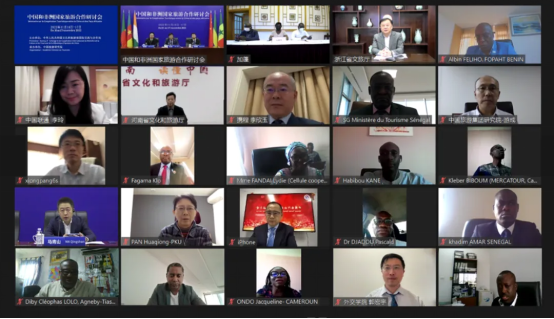
From November 16 to 17,2022, Associate Professor Guo Hongyu from the School of International Economics was invited to attend the "China and African Countries Tourism Cooperation Seminar" hosted by the Bureau of International Exchange and Cooperation of the Ministry of Culture and Tourism and organized by the China Tourism Academy. He delivered a keynote speech on "Opportunities and Prospects for China-Africa Tourism Cooperation under the Framework of a China-Africa Community with a Shared Future in the New Era." During the seminar, Associate Professor Guo Hongyu exchanged views with government officials from African countries such as Benin, Cameroon, Gabon, Côte dIvoire, and Senegal, domestic central and local tourism management departments, as well as experts and scholars from industry institutions including the China Tourism Group Research Institute and the China Travel Service Association.
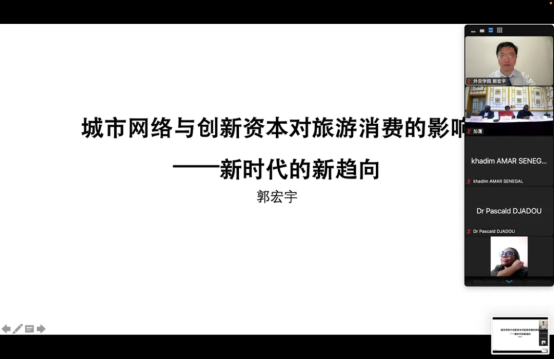
Associate Professor Guo Hongyu delivered a keynote speech titled "Urban Networks and Innovation Capital: The New Trends in Tourism Consumption in the New Era". In his presentation, Guo emphasized that the new era demands fresh perspectives to redefine urban networks and reposition capitals influence. Specifically, he highlighted two critical aspects: First, urban networks should be viewed beyond geographical boundaries. The international flow of goods in the new era encompasses substantial non-physical goods that transcend physical constraints, while the infrastructure required for capital, labor, and technology flows also exceeds geographical limitations. This necessitates expanding network analysis of tourism nodes to virtual networks, redefining their locational advantages, and reorienting tourism development goals. Second, the impact of innovation capital must be prioritized. The world has entered an era dominated by innovation capital, which plays a significant role in social financing. The upgrading of traditional tourism industries and the emergence of new tourism sectors have attracted substantial innovation capital. Consequently, tourism development now aligns with capital operations, exhibiting new characteristics such as construction oriented toward investors rather than consumers, and planning focused on short-term monetization rather than long-term development.
Guo Hongyu elaborates on the dual impacts of new urban networks on tourist cities: Firstly, the locational advantages of these networks enhance consumer appeal. Tourist cities now attract visitors not only through traditional geographic routes but also via digital pathways. Their appeal stems not solely from natural resources like tourism infrastructure, but also from the strategic positioning within modern urban networks. This stable locational advantage ensures sustained visitor flow, establishing tourist cities as enduring consumption hubs. Secondly, new urban networks foster diverse consumer demands. As nodes in these networks, tourist cities accommodate varied consumption objectives. The advanced infrastructure and enhanced mobility of physical and intangible goods necessitate catering to multifaceted needs. By embracing diverse consumption patterns, tourist cities can attract business travelers with different preferences. To accommodate this diversity, cities should adopt pragmatic approaches to consumption models and their associated trends, positioning their own fashion strategies as commercially viable and practical, thereby better harmonizing differences among various consumer objectives.
The capital dynamics of innovative capital in tourism development have been further analyzed into two key aspects. Firstly, tourism development now aligns with capitals self-promotion needs. While innovative capital seeks to demonstrate its value, the tourism industry, under its influence, shifts focus from delivering leisure experiences to investors to showcasing capital accumulation. Capital has eroded the substantive content of traditional tourism resources, prioritizing superficial forms. The pursuit of capital-driven operational models has become a dominant trend in tourism development. Secondly, innovative capital accelerates industry transformation. Rather than emphasizing long-term sustainable development, it focuses on a few valuation-driven metrics to secure higher securities market valuations and monetize tourism assets. Given that most innovative capital cycles last under a decade, the tourism sector now experiences accelerated development and transformation.
This meeting enhanced the understanding between China and African countries in the field of tourism, presented opportunities for cooperation in the overlapping areas of tourism, economy, and international relations between China and African countries, demonstrated the close integration of theoretical research and industry practice, and also provided valuable inspiration for our institutes research on economic diplomacy.
