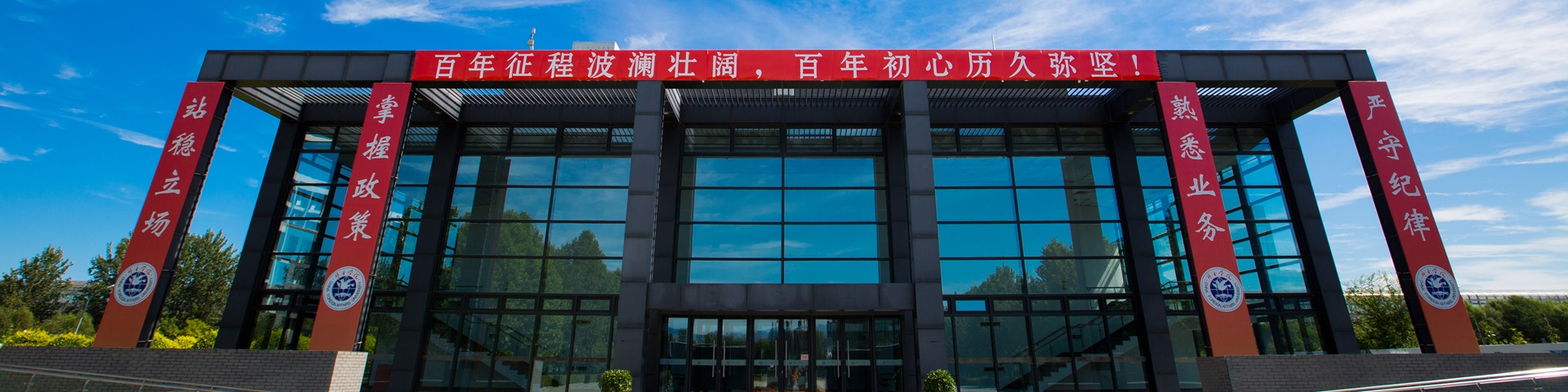
China Foreign Affairs University (CFAU) is a small-scale, high-caliber university with distinctive features directly affiliated with China’s Ministry of Foreign Affairs (MFA). It is dedicated to grooming top diplomatic and foreign affairs talent to serve China’s diplomatic cause. CFAU was officially established on September 10, 1955, under the initiative of Premier Zhou Enlai and with approval of the Central Committee of the Communist Party of China (CPC) and Chairman Mao Zedong. Premier Zhou personally inscribed the university’s name, while Chen Yi, then Vice Premier and Minister of Foreign Affairs, served as its first president.
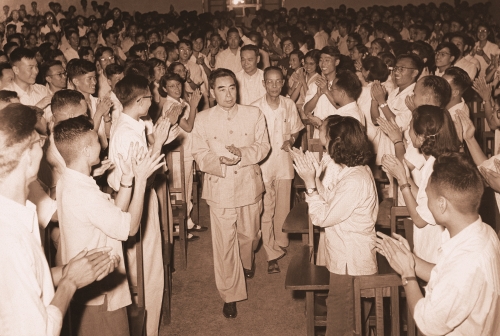
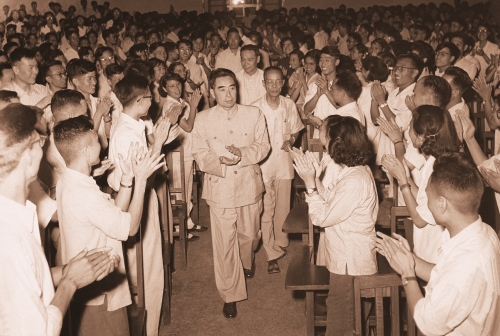
Premier Zhou Enlai addressing students, faculty and staff in 1957
Since its founding, CFAU has received kind attention from the CPC and state leaders. Premier Zhou Enlai, Vice Premier Chen Yi, Vice Premier Qian Qichen, as well as successive leading officials of the Ministry of Foreign Affairs including Tang Jiaxuan, Dai Bingguo, Li Zhaoxing, Yang Jiechi, and Wang Yi have all visited the university and provided guidance. On the occasions of CFAU’s 40th and 50th anniversaries, President Jiang Zemin, Premier Li Peng, Vice Premier Li Lanqing, Vice Premier Qian Qichen and other CPC and state leaders sent congratulatory messages and inscriptions, expressing their high expectations. In September 2012, Premier Wen Jiabao personally inscribed “The Cradle of Chinese Diplomats” for CFAU.
Since the 18th National Congress of the Communist Party of China in 2012, under the strong leadership of the Party Central Committee with Comrade Xi Jinping at its core, CFAU has faithfully implemented the Party’s education policy. It has adhered to the school motto formulated by Premier Zhou Enlai, “Unswerving Loyalty, Mastery of Policies, Professional Competency, and Observance of Discipline”, while fulfilling its responsibility to “foster virtue through education, serve the diplomatic cause”, and upholding its original mission of “nurturing talent for the Party and the nation”. In line with the goals of strengthening education in the new era, it coordinates and promotes reform in talent cultivation, research paradigms, educational models, and governance systems, and strive to cultivate personnel for China’s diplomatic cause in the new era, who are “loyal to the Party, live up to its responsibilities, ready and able to defend China’s interests, and act in strict compliance with disciplines”.
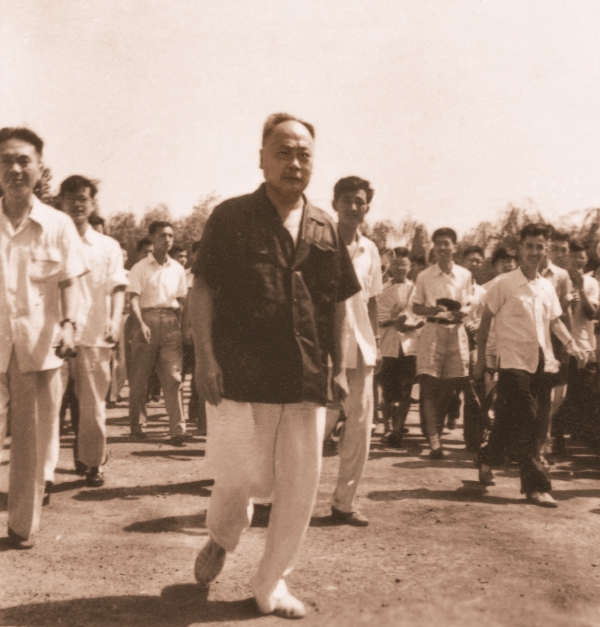
Vice Premier Chen Yi inspecting the University in 1956
CFAU adheres to the philosophy of taking pride in diplomatic and international studies with high-level proficiency in foreign languages. It advocates a learning style integrating theory with practice, seeking truth from facts, and emphasizing diligence, rigor, and all-round development in terms of sound moral grounding, intellectual ability, physical vigor, aesthetic sensibility, and work skills. In ideological and political education, it focuses on moral cultivation, especially in patriotism, collectivism, socialism, awareness of national conditions, and organizational discipline. In teaching, equal emphasis is placed on language proficiency and professional competence. The university strives to cultivate young people into high-quality, interdisciplinary talent, who have a firm political stance and demonstrate “true patriotism, a global vision, professional expertise, great proficiency in foreign languages”.
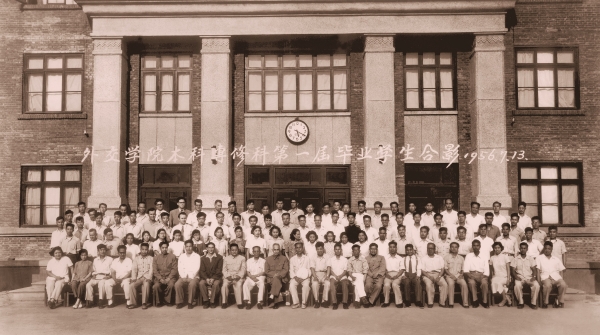
The first graduates of the University in 1956
To meet the demand for diverse talent in China’s reform and opening-up and diplomatic work, CFAU has adopted a “multi-specification, multi-level, and multi-form” system, enrolling doctoral, master’s, and undergraduate students. The university comprises 10 major teaching units, including Department of Diplomacy and Foreign Affairs Management,Department of English and International Studies, Department of Foreign Languages, Department of International Law, School of International Economics, Department of Basic Education, Institute of International Relations, School of International Education, Institute of Asian Studies and School of Marxism Studies. Additionally, CFAU has nearly 40 research institutes and centers, including National Youth Diplomatic Research Center and the China International Law Research Center.
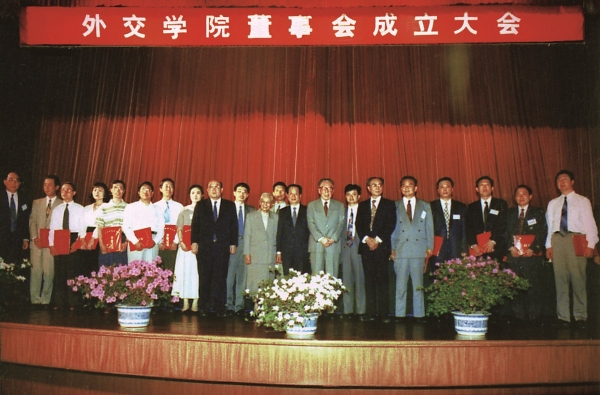
Founding ceremony of the CFAU Board of Trustees in 1995
CFAU was the first university in China to establish Diplomatic Studies as an undergraduate major. In 1979, it became one of the first universities authorized to confer Master’s Degrees in International Relations and International Law. Its discipline of Political Science is now part of China’s prestigious “Double First-Class” initiative. The university boasts 6 nation-level first class undergraduate programs: Diplomatic Studies, English and International Studies, Translation and Interpretation, French, International Law, and International Economics and Trade, as well as 2 province-level first-class undergraduate major: French and International Law. The English and International Studies program is recognized as both a Model Program of Beijing City and Key Discipline of Beijing City, as well as a Model National Program. Currently, CFAU hosts 1 post-doctoral research station, 1 first-level discipline doctoral program with 5 second-level doctoral programs, 5 first-level discipline master’s programs with 20 second-level master’s programs, 4 professional master’s degree programs, and 12 undergraduate majors. Additionally, CFAU serves as home to 3 national academic organizations—China National Association for International Studies, the Chinese Society of International Law and the Society for Diplomatic History of the People’s Republic of China—as well as the Research Centre for Beijing International Exchanges and Foreign Affairs Administration under the auspice of the Beijing municipality.
CFAU has signed agreements with 182 universities and institutions across 73 countries and regions. The university regularly sends outstanding undergraduate and graduate students to study at universities in the US, UK, Russia, Japan, France, Germany, Italy, Norway, the Netherlands, and Switzerland. In January 2013, CFAU signed an agreement with the University of French Polynesia (UPF) to co-establish a Confucius Institute.
Over the past 70 years, CFAU has steadfastly upheld the principle of serving China’s diplomatic cause, producing approximately 20,000 students. Amongst these alumni, nearly 600 have served as ambassadors to foreign countries, making vital contributions to New China’s diplomatic undertakings. Wherever China’s five-star red national flag flies around the world, CFAU graduates are present.
As China’s overall national strength continues to grow, the demand for exceptional diplomatic and foreign service professionals has increased significantly. To meet this need, and under the guidance and support of the CPC Central Committee, the State Council, and the Ministry of Foreign Affairs, CFAU established the Shahe Campusin September 2012 to complement the existing Zhanlanguan Road Campus. The new campus provides students with a spacious, pleasant learning environment with modern facilities that embodies CFAU’s distinct educational philosophy of openness, inclusiveness, rational thinking, and humanistic care.
On September 10, 2012, then Premier Wen Jiabao attended the unveiling ceremony of bronze statue of Zhou Enlai and Chen Yi in the Shahe Campus. In his keynote address, he articulated his expectations for the university: “China Foreign Affairs University must build first-class faculty, disciplines, and vision, and contribute first-class talent to the nation’s diplomatic service.”
On January 3, 2014, the Agreement of Co-Building China Foreign Affairs University between the Ministry of Foreign Affairs and the Ministry of Education was signed at the Diaoyutai State Guesthouse. Under this agreement, the two ministries established a coordination mechanism to increase support for the university across multiple areas, including policy guidance, financing resources, academic disciplines, research initiatives, talent cultivation, personnel training, and faculty development.
On September 21, 2017, the Ministry of Education, the Ministry of Finance, and the National Development and Reform Commission jointly released a list of institutions for the country’s “Double First-Class” initiative, which aims to develop world-class universities and world-class disciplines. CFAU was included in this prestigious selection. The Party and the State have entrusted CFAU with the honorable mission of developing into a university with world-class disciplines.
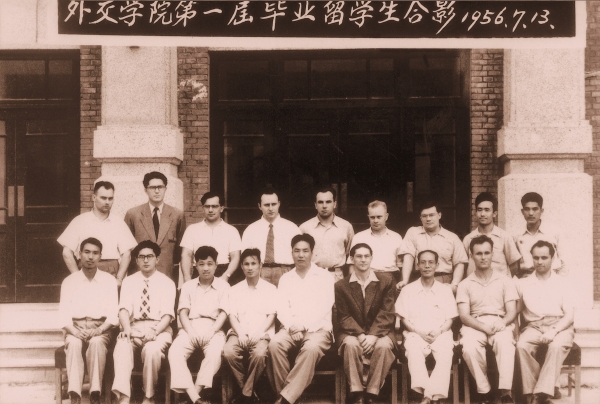
The first international graduates of the University
On January 2, 2025, with the approval of the CPC Central Committee, the Research Center on Building a Community with a Shared Future for Humanity was officially inaugurated at CFAU. Wang Yi, member of the Political Bureau of the CPC Central Committee and Minister of Foreign Affairs, delivered a speech at the ceremony. The center is committed to deepening research and international communication on this important concept, building strong research teams, producing landmark outcomes, and creating knowledge, academic, and discourse systems with global influence.
The 20th National Congress of the Communist Party of China has called for building a leading country in education, and CFAU has embraced new development opportunities. The university will continue to explore new approaches to cultivate students equipped for the multidimensional demands of diplomacy and foreign services, establish new patterns of comprehensive education, strengthen academic disciplines, deepen teaching reforms, and improve educational quality. Through the collective efforts of faculty, staff and students, CFAU aims to become an incubator for China’s diplomat talent, a leader in theoretical research and innovation of China’s diplomacy, and a vital force in international exchanges and cooperation. The university remains committed to understanding the strategic significance of education and contributing to Chinese modernization.
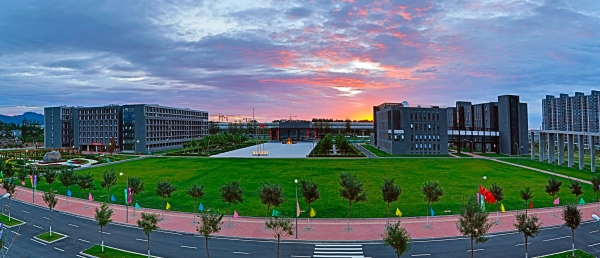
Panorama of the University new campus