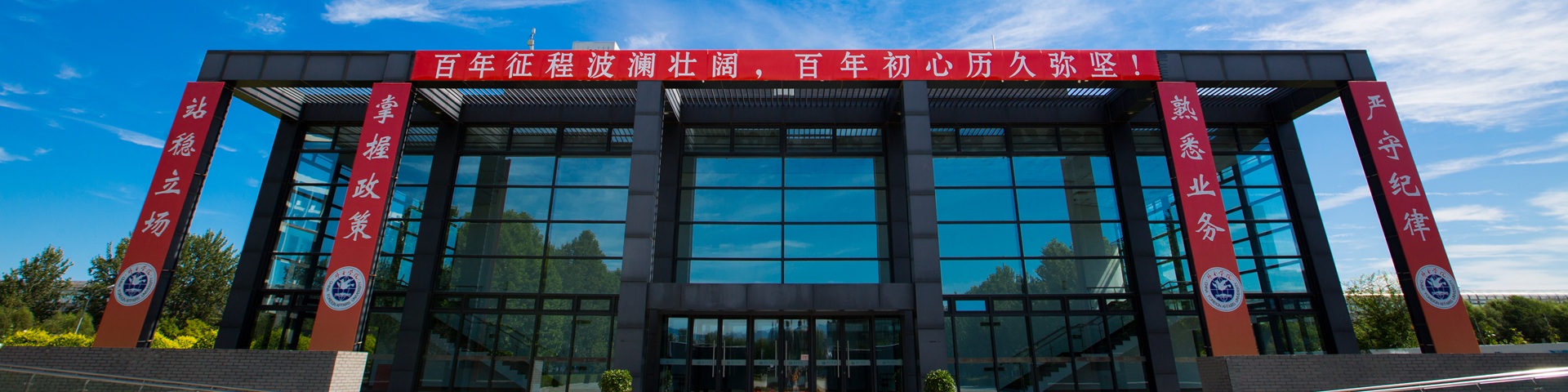
On the afternoon of November 26 at 2:00 PM, at the invitation of the School of International Economics, Mr. Huang Jiefu, founder of AEX Holdings (Hong Kong), senior carbon market expert, and alumnus, delivered a special lecture titled “The Internationalization of China's Carbon Trading” at the Shahe Campus. Professor Ou Minggang, Dean of the School of International Economics, presided over the lecture. Attendees included Mr. Zeng Xiongjun, Secretary of the Party Branch of the School of International Economics; Mr. Li Tao from the Department of International Finance; and a number of students from the School of International Economics.
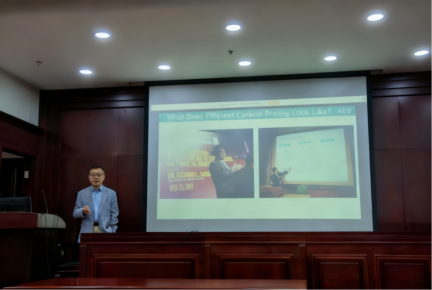
Mr. Huang Jiefu possesses over 20 years of experience in carbon markets. From 2005 to 2010, he served as Vice President for Asia at the Chicago Climate Exchange (CCX), where he participated in the negotiations, establishment, and operations of the Tianjin Emissions Exchange—a joint venture between CCX and China National Petroleum Corporation (CNPC). From 2010 to 2016, he held the position of Managing Director for Greater China at Intercontinental Exchange (ICE), the parent company of the New York Stock Exchange.
Mr. Huang Jiefu first drew upon his extensive international experience to review how the United States initially employed market-based mechanisms to control sulfur dioxide emissions, emphasizing the critical importance for China of learning from the mature carbon markets of Europe and America. He conducted an in-depth analysis of the core issues currently facing China's carbon market, noting that the market has already achieved interprovincial liquidity for emission allowances. The key challenge has now shifted from “how to allocate allowances” to “how to achieve effective pricing.”
Against this backdrop, Hong Kong has been entrusted with a significant role. Mr. Huang Jiefu proposed that Hong Kong could leverage its unique strengths in green finance by connecting with international carbon pricing mechanisms, thereby providing reference points for China's still-evolving domestic carbon pricing framework. He emphasized that an effective carbon market requires clear forward price curves and diverse institutional participants. However, China's current development faces institutional barriers such as the Futures Law and accounting standards, while green standards differ from international norms, potentially leading to Chinese enterprises' green achievements not being internationally recognized. He recommended that China's carbon market development should follow a gradual approach, starting with over-the-counter (OTC) markets. Once trading volumes accumulate and the market matures, it can progressively expand into spot and futures markets for the China Certified Emission Reduction (CCER) voluntary emissions reduction scheme. The electronic OTC platform model adopted by AEX, which he founded and which resembles that of the Intercontinental Exchange (ICE) in the United States, provides a viable practical reference for China.
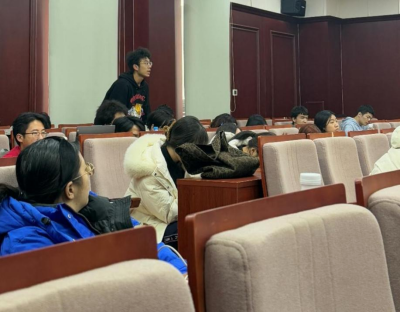
The lecture also introduced AsiaRec, an innovative non-profit organization based in Hong Kong. This institution is dedicated to bridging the gap between domestic and international green certification standards, particularly by enabling precise time-based matching between wind and solar power generation and production through its “hourly green certificates.” This approach addresses international regulations such as the EU's Carbon Border Adjustment Mechanism (CBAM), providing green support for exporting enterprises. Addressing key market challenges—including inconsistent domestic and international green certificate issuance standards, insufficient data transparency, lack of green attribute uniqueness, and imperfect price discovery mechanisms—Mr. Huang Jiefu proposed a series of solutions. These include leveraging Hong Kong's platform to harmonize standards, applying blockchain technology to ensure data authenticity and uniqueness, and utilizing Hong Kong's status as an international financial center to establish more efficient pricing mechanisms.
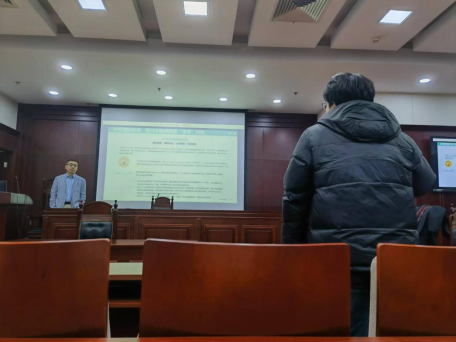
During the Q&A session, in response to a student's question about the price inversion between China's domestic mandatory market and CCERs, Mr. Huang Jiefu pointed out that the root cause lies in an imperfect pricing mechanism. This precisely highlights the necessity of aligning Hong Kong's pricing mechanism with international standards.
During the lecture, students actively engaged with Mr. Huang, exchanging knowledge and insights. Mr. Huang Jiefu's presentation systematically outlined the necessity and feasible pathways for internationalizing China's carbon market, highlighting Hong Kong's pivotal role as a bridge connecting China's carbon market with global counterparts. The session provided students with cutting-edge market insights and profound policy implications.
