On November 8, 2023, Associate Professor Guo Hongyu, Deputy Director of the International Finance Department at the International Economics College, was invited to attend the China-Africa Cultural and Tourism Cooperation Forum in Jinhua City, Zhejiang Province. The forum was jointly organized by the Bureau of International Exchange and Cooperation of the Ministry of Culture and Tourism of the Peoples Republic of China, the China Tourism Academy, the Zhejiang Provincial Department of Culture and Tourism, and the Jinhua Municipal Peoples Government. The meeting aimed to actively respond to President Xi Jinpings initiative for jointly building the "Belt and Road" and the Global Civilization Initiative, thoroughly implement the "China-Africa Cooperation Forum-Dakar Action Plan (2022-2024)", and further promote friendly mutual assistance between the Chinese and African peoples, as well as cultural exchanges and tourism cooperation between China and Africa.
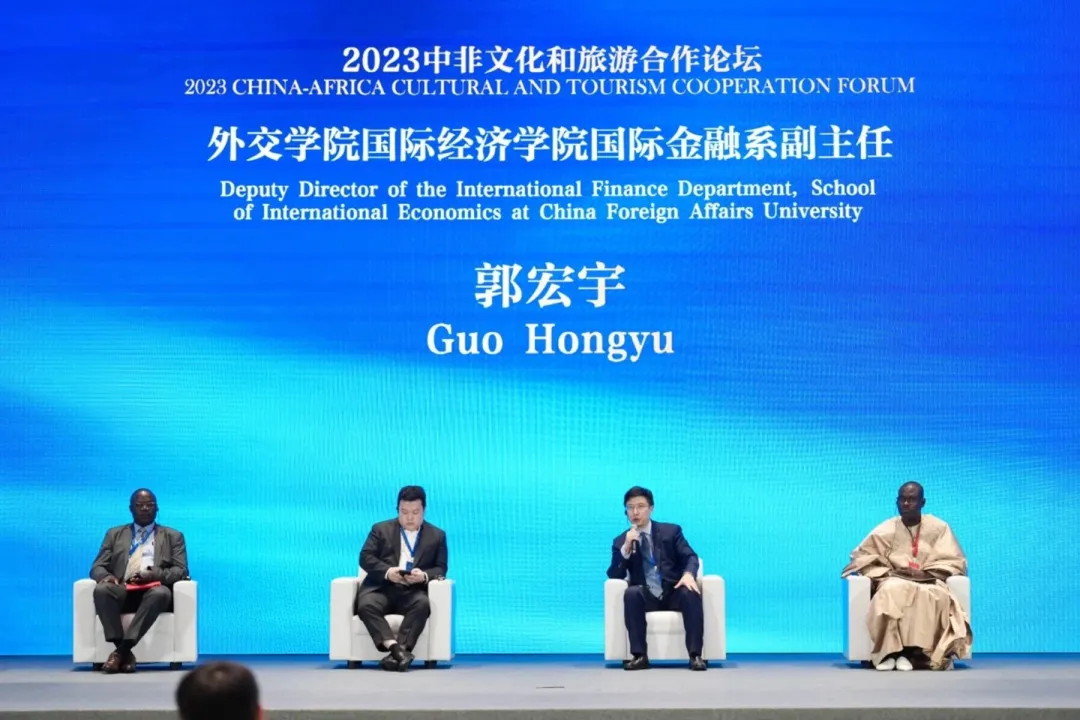
Professor Guo Hongyu delivered a keynote speech at the forum and answered questions posed by the moderator. In his speech, Professor Guo Hongyu examined the development of global tourism from a financial perspective after the pandemic and analyzed the mechanisms by which a community with a shared future empowers global tourism. He argued that the current global tourism industry can no longer be viewed as an isolated sector, as it requires substantial investments in mobile capital, labor, and technology. Overall, the development of global cross-border infrastructure has led to a gradual decline in the circulation costs of these production factors. Tourism in each country competes for resources in distant regions and with other industries, thereby exposing the tourism sector to significant systemic risks from the global stage. Therefore, the tourism industry in each country needs to abandon the practice of "self-preservation" and seek common interests and values globally. First, it is necessary to break geographical limitations and pursue the common development of global tourism. Second, it is essential to transcend industry boundaries and seek common development between tourism and other industries. Third, attention must be paid to the correlation and coordination between tourism and global risk issues to address systemic risks from the global stage. The concept of a community with a shared future in China focuses on seeking the greatest common divisor. In the process of integrating the goals of "peace and development" from diplomatic practices into the development objectives of tourism, countries need to adopt a holistic perspective and a "holistic sustainability" viewpoint.Develop tourism and integrate it into the construction of "community of common destiny".
The conference gathered representatives from multiple African nations, including Seyasi, State Minister of Tourism of Ethiopia, and Atisu, Deputy Director of the Cooperation and Vocational Department at Côte d Ivoires Ministry of Tourism and Leisure. Through the high-level dialogue titled "Deep Integration of Culture and Tourism: Empowering China-Africa Tourism Cooperation," participants explored the deepening of cultural and tourism collaboration between China and Africa. This initiative provided valuable insights for our institutes economic diplomacy research, particularly in the context of economic diplomacy with Africa.
