On the afternoon of July 3, School of International Economics successfully hosted a special academic lecture titled “The Development, Impact, and Regulatory Framework of Stablecoins” at the Exhibition Road Campus. The event featured Dr. Zhu Taihui, Distinguished Senior Research Fellow at the National Institute of Financial Research, as the keynote speaker, drawing a large audience of faculty and students from the school.
Dr. Zhu first systematically interpreted the core characteristics of stablecoins, noting that as a special category of cryptocurrency, they achieve value stability by pegging to fiat currencies or highly liquid assets, combining the dual advantages of technological innovation and financial stability. Subsequently, he conducted an in-depth analysis across five dimensions: technical architecture, application scenarios, global impact, regulatory policies, and development prospects. On the technical front, he meticulously dissected the operational mechanisms of various stablecoins. Regarding market applications, he focused on exploring their innovative practices in cross-border payments, DeFi, and other domains. Concerning international implications, he thoroughly examined the potential disruptions stablecoins pose to traditional monetary systems.
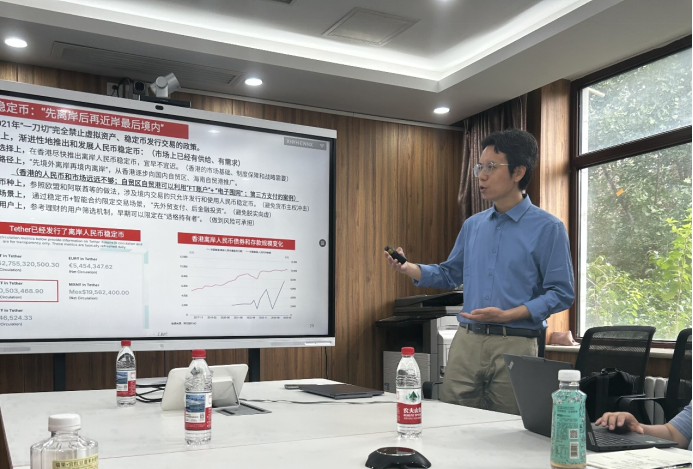
Dr. Zhu conducted an in-depth analysis of the regulatory approaches toward stablecoins adopted by major global economies such as the United States, the European Union, and Singapore. He noted that these regions generally pursue a dual-pronged regulatory strategy of “supporting innovation while guarding against risks,” balancing development and risk prevention through institutional designs including licensing management, reserve fund custody, and information disclosure. He specifically highlighted the shift in U.S. policy from strict control to supporting innovation, while simultaneously strengthening anti-money laundering oversight. For China, Dr. Zhu recommended leveraging the unique advantages of the Guangdong-Hong Kong-Macao Greater Bay Area to pilot a renminbi-pegged stablecoin. By “pioneering and testing first,” China could accumulate experience and build a regulatory framework that safeguards security while fostering innovation, thereby enhancing its competitiveness on the global stage.
This lecture offered rich content and unique perspectives, providing faculty and students with a valuable learning opportunity to gain deeper insights into the cutting-edge developments in digital currencies. At the conclusion of the lecture, Dr. Zhu engaged in an in-depth exchange with the audience on topics including the future trends of digital currencies and the application of regulatory technology.
